Cachified allows you to cache values with support for time-to-live (ttl), stale-while-revalidate (swr), cache value validation, batching, and type-safety.
npm install @epic-web/cachified 



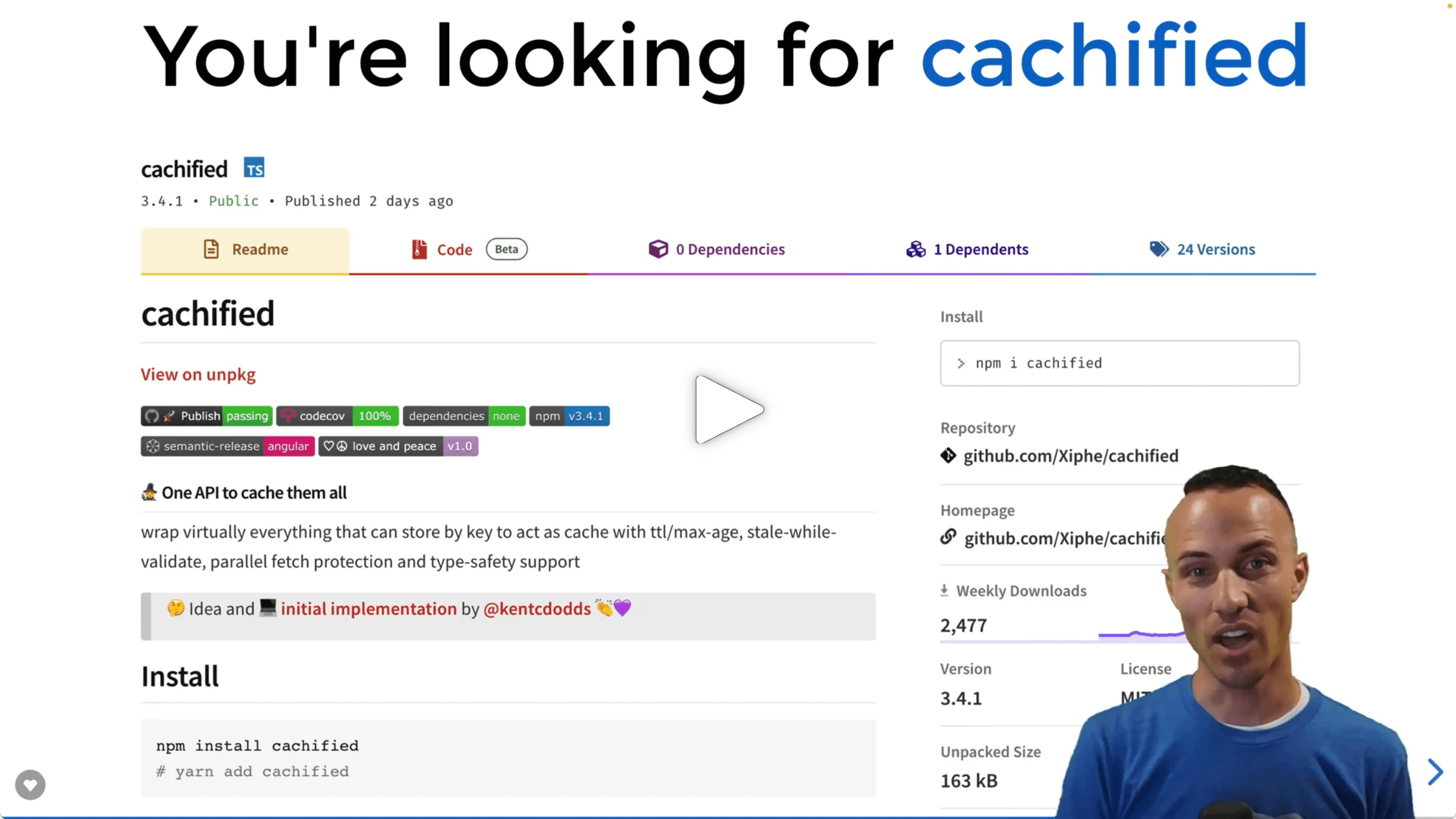
Watch the talk "Caching for Cash 🤑" on EpicWeb.dev:
npm install @epic-web/cachified # yarn add @epic-web/cachifiedimport{LRUCache}from'lru-cache';import{cachified,CacheEntry,Cache,totalTtl}from'@epic-web/cachified';/* lru cache is not part of this package but a simple non-persistent cache */constlruInstance=newLRUCache<string,CacheEntry>({max: 1000});constlru: Cache={set(key,value){constttl=totalTtl(value?.metadata);returnlruInstance.set(key,value,{ttl: ttl===Infinity ? undefined : ttl,start: value?.metadata?.createdTime,});},get(key){returnlruInstance.get(key);},delete(key){returnlruInstance.delete(key);},};functiongetUserById(userId: number){returncachified({key: `user-${userId}`,cache: lru,asyncgetFreshValue(){/* Normally we want to either use a type-safe API or `checkValue` but to keep this example simple we work with `any` */constresponse=awaitfetch(`https://jsonplaceholder.typicode.com/users/${userId}`,);returnresponse.json();},/* 5 minutes until cache gets invalid * Optional, defaults to Infinity */ttl: 300_000,});}// Let's get through some calls of `getUserById`:console.log(awaitgetUserById(1));// > logs the user with ID 1// Cache was empty, `getFreshValue` got invoked and fetched the user-data that// is now cached for 5 minutes// 2 minutes laterconsole.log(awaitgetUserById(1));// > logs the exact same user-data// Cache was filled an valid. `getFreshValue` was not invoked// 10 minutes laterconsole.log(awaitgetUserById(1));// > logs the user with ID 1 that might have updated fields// Cache timed out, `getFreshValue` got invoked to fetch a fresh copy of the user// that now replaces current cache entry and is cached for 5 minutesinterfaceCachifiedOptions<Value>{/** * Required * * The key this value is cached by * Must be unique for each value */key: string;/** * Required * * Cache implementation to use * * Must conform with signature * - set(key: string, value: object): void | Promise<void> * - get(key: string): object | Promise<object> * - delete(key: string): void | Promise<void> */cache: Cache;/** * Required * * Function that is called when no valid value is in cache for given key * Basically what we would do if we wouldn't use a cache * * Can be async and must return fresh value or throw * * receives context object as argument * - context.metadata.ttl?: number * - context.metadata.swr?: number * - context.metadata.createdTime: number * - context.background: boolean */getFreshValue: GetFreshValue<Value>;/** * Time To Live; often also referred to as max age * * Amount of milliseconds the value should stay in cache * before we get a fresh one * * Setting any negative value will disable caching * Can be infinite * * Default: `Infinity` */ttl?: number;/** * Amount of milliseconds that a value with exceeded ttl is still returned * while a fresh value is refreshed in the background * * Should be positive, can be infinite * * Default: `0` */staleWhileRevalidate?: number;/** * Alias for staleWhileRevalidate */swr?: number;/** * Validator that checks every cached and fresh value to ensure type safety * * Can be a standard schema validator or a custom validator function * @see https://github.com/standard-schema/standard-schema?tab=readme-ov-file#what-schema-libraries-implement-the-spec * * Value considered ok when: * - schema succeeds * - validator returns * - true * - migrate(newValue) * - undefined * - null * * Value considered bad when: * - schema throws * - validator: * - returns false * - returns reason as string * - throws * * A validator function receives two arguments: * 1. the value * 2. a migrate callback, see https://github.com/epicweb-dev/cachified#migrating-values * * Default: `undefined` - no validation */checkValue?: |CheckValue<Value>|StandardSchemaV1<unknown,Value>|Schema<Value,unknown>;/** * Set true to not even try reading the currently cached value * * Will write new value to cache even when cached value is * still valid. * * Default: `false` */forceFresh?: boolean;/** * Whether or not to fall back to cache when getting a forced fresh value * fails * * Can also be a positive number as the maximum age in milliseconds that a * fallback value might have * * Default: `Infinity` */fallbackToCache?: boolean|number;/** * Promises passed to `waitUntil` represent background tasks which must be * completed before the server can shutdown. e.g. swr cache revalidation * * Useful for serverless environments such as Cloudflare Workers. * * Default: `undefined` */waitUntil?: (promise: Promise<unknown>)=>void;/** * Trace ID for debugging, is stored along cache metadata and can be accessed * in `getFreshValue` and reporter */traceId?: any;}There are some adapters available for common caches. Using them makes sure the used caches cleanup outdated values themselves.
- Adapter for redis : cachified-redis-adapter
- Adapter for redis-json : cachified-redis-json-adapter
- Adapter for Cloudflare KV : cachified-adapter-cloudflare-kv repository
- Adapter for SQLite : cachified-adapter-sqlite
Specify a time window in which a cached value is returned even though it's ttl is exceeded while the cache is updated in the background for the next call.
import{cachified}from'@epic-web/cachified';constcache=newMap();functiongetUserById(userId: number){returncachified({ttl: 120_000/* Two minutes */,staleWhileRevalidate: 300_000/* Five minutes */, cache,key: `user-${userId}`,asyncgetFreshValue(){constresponse=awaitfetch(`https://jsonplaceholder.typicode.com/users/${userId}`,);returnresponse.json();},});}console.log(awaitgetUserById(1));// > logs the user with ID 1// Cache is empty, `getFreshValue` gets invoked and and its value returned and// cached for 7 minutes total. After 2 minutes the cache will start refreshing in background// 30 seconds laterconsole.log(awaitgetUserById(1));// > logs the exact same user-data// Cache is filled an valid. `getFreshValue` is not invoked, cached value is returned// 4 minutes laterconsole.log(awaitgetUserById(1));// > logs the exact same user-data// Cache timed out but stale while revalidate is not exceeded.// cached value is returned immediately, `getFreshValue` gets invoked in the// background and its value is cached for the next 7 minutes// 30 seconds laterconsole.log(awaitgetUserById(1));// > logs fresh user-data from the previous call// Cache is filled an valid. `getFreshValue` is not invoked, cached value is returnedWe can use forceFresh to get a fresh value regardless of the values ttl or stale while validate
import{cachified}from'@epic-web/cachified';constcache=newMap();functiongetUserById(userId: number,forceFresh?: boolean){returncachified({ forceFresh,/* when getting a forced fresh value fails we fall back to cached value as long as it's not older then 5 minutes */fallbackToCache: 300_000/* 5 minutes, defaults to Infinity */, cache,key: `user-${userId}`,asyncgetFreshValue(){constresponse=awaitfetch(`https://jsonplaceholder.typicode.com/users/${userId}`,);returnresponse.json();},});}console.log(awaitgetUserById(1));// > logs the user with ID 1// Cache is empty, `getFreshValue` gets invoked and and its value returnedconsole.log(awaitgetUserById(1,true));// > logs fresh user with ID 1// Cache is filled an valid. but we forced a fresh value, so `getFreshValue` is invokedIn practice we can not be entirely sure that values from cache are of the types we assume. For example other parties could also write to the cache or code is changed while cache stays the same.
import{cachified,createCacheEntry}from'@epic-web/cachified';constcache=newMap();/* Assume something bad happened and we have an invalid cache entry... */cache.set('user-1',createCacheEntry('INVALID')asany);functiongetUserById(userId: number){returncachified({checkValue(value: unknown){if(!isRecord(value)){/* We can either throw to indicate a bad value */thrownewError(`Expected user to be object, got ${typeofvalue}`);}if(typeofvalue.email!=='string'){/* Or return a reason/message string */return`Expected user-${userId} to have an email`;}if(typeofvalue.username!=='string'){/* Or just say no... */returnfalse;}/* undefined, true or null are considered OK */}, cache,key: `user-${userId}`,asyncgetFreshValue(){constresponse=awaitfetch(`https://jsonplaceholder.typicode.com/users/${userId}`,);returnresponse.json();},});}functionisRecord(value: unknown): value is Record<string,unknown>{returntypeofvalue==='object'&&value!==null&&!Array.isArray(value);}console.log(awaitgetUserById(1));// > logs the user with ID 1// Cache was not empty but value was invalid, `getFreshValue` got invoked and// and the cache was updatedconsole.log(awaitgetUserById(1));// > logs the exact same data as above// Cache was filled an valid. `getFreshValue` was not invokedℹ️
checkValueis also invoked with the return value ofgetFreshValue
Type-safety with schema libraries
We can also use zod, valibot or other libraries implementing the standard schema spec to ensure correct types
import{cachified,createCacheEntry}from'@epic-web/cachified';importzfrom'zod';constcache=newMap();/* Assume something bad happened and we have an invalid cache entry... */cache.set('user-1',createCacheEntry('INVALID')asany);functiongetUserById(userId: number){returncachified({checkValue: z.object({email: z.string(),}), cache,key: `user-${userId}`,asyncgetFreshValue(){constresponse=awaitfetch(`https://jsonplaceholder.typicode.com/users/${userId}`,);returnresponse.json();},});}console.log(awaitgetUserById(1));// > logs the user with ID 1// Cache was not empty but value was invalid, `getFreshValue` got invoked and// and the cache was updatedconsole.log(awaitgetUserById(1));// > logs the exact same data as above// Cache was filled an valid. `getFreshValue` was not invokedWe can create versions of cachified with defaults so that we don't have to specify the same options every time.
import{configure}from'@epic-web/cachified';import{LRUCache}from'lru-cache';/* lruCachified now has a default cache */constlruCachified=configure({cache: newLRUCache<string,CacheEntry>({max: 1000}),});constvalue=awaitlruCachified({key: 'user-1',getFreshValue: async()=>'ONE',});During normal app lifecycle there usually is no need for this but for maintenance and testing these helpers might come handy.
import{createCacheEntry,assertCacheEntry,isExpired,cachified,}from'@epic-web/cachified';constcache=newMap();/* Manually set an entry to cache */cache.set('user-1',createCacheEntry('[email protected]',/* Optional CacheMetadata */{ttl: 300_000,swr: Infinity},),);/* Receive the value with cachified */constvalue: string=awaitcachified({ cache,key: 'user-1',getFreshValue(){thrownewError('This is not called since cache is set earlier');},});console.log(value);// > logs "[email protected]"/* Manually get a value from cache */constentry: unknown=cache.get('user-1');assertCacheEntry(entry);// will throw when entry is not a valid CacheEntryconsole.log(entry.value);// > logs "[email protected]"/* Manually check if an entry is expired */constexpired=isExpired(entry.metadata);console.log(expired);// > logs true, "stale" or false/* Manually remove an entry from cache */cache.delete('user-1');When the format of cached values is changed during the apps lifetime they can be migrated on read like this:
import{cachified,createCacheEntry}from'@epic-web/cachified';constcache=newMap();/* Let's assume we've previously only stored emails not user objects */cache.set('user-1',createCacheEntry('[email protected]'));functiongetUserById(userId: number){returncachified({checkValue(value,migrate){if(typeofvalue==='string'){returnmigrate({email: value});}/* other validations... */},key: 'user-1', cache,getFreshValue(){thrownewError('This is never called');},});}console.log(awaitgetUserById(1));// > logs{email: 'someone@example.org' }// Cache is filled and invalid but value can be migrated from email to user-object// `getFreshValue` is not invokedconsole.log(awaitgetUserById(1));// > logs the exact same data as above// Cache is filled an valid.Soft-purging cached data has the benefit of not immediately putting pressure on the app to update all cached values at once and instead allows to get them updated over time.
More details: Soft vs. hard purge
import{cachified,softPurge}from'@epic-web/cachified';constcache=newMap();functiongetUserById(userId: number){returncachified({ cache,key: `user-${userId}`,ttl: 300_000,asyncgetFreshValue(){constresponse=awaitfetch(`https://jsonplaceholder.typicode.com/users/${userId}`,);returnresponse.json();},});}console.log(awaitgetUserById(1));// > logs user with ID 1// cache was empty, fresh value was requested and is cached for 5 minutesawaitsoftPurge({ cache,key: 'user-1',});// This internally sets the ttl to 0 and staleWhileRevalidate to 300_000// 10 seconds laterconsole.log(awaitgetUserById(1));// > logs the outdated, soft-purged data// cache has been soft-purged, the cached value got returned and a fresh value// is requested in the background and again cached for 5 minutes// 1 minute laterconsole.log(awaitgetUserById(1));// > logs the fresh data that got refreshed by the previous callawaitsoftPurge({ cache,key: 'user-1',// manually overwrite how long the stale data should stay in cachestaleWhileRevalidate: 60_000/* one minute from now on */,});// 2 minutes laterconsole.log(awaitgetUserById(1));// > logs completely fresh dataℹ️ In case we need to fully purge the value, we delete the key directly from our cache
There are scenarios where we want to change the cache time based on the fresh value (ref #25). For example when an API might either provide our data or null and in case we get an empty result we want to retry the API much faster.
import{cachified}from'@epic-web/cachified';constcache=newMap();constvalue: null|string=awaitcachified({ttl: 60_000/* Default cache of one minute... */,asyncgetFreshValue(context){constresponse=awaitfetch(`https://jsonplaceholder.typicode.com/users/1`,);constdata=awaitresponse.json();if(data===null){/* On an empty result, prevent caching */context.metadata.ttl=-1;}returndata;}, cache,key: 'user-1',});In case multiple values can be requested in a batch action, but it's not clear which values are currently in cache we can use the createBatch helper
import{cachified,createBatch}from'@epic-web/cachified';constcache=newMap();asyncfunctiongetFreshValues(idsThatAreNotInCache: number[]){constres=awaitfetch(`https://example.org/api?ids=${idsThatAreNotInCache.join(',')}`,);constdata=awaitres.json();// Validate data here...returndata;}functiongetUsersWithId(ids: number[]){constbatch=createBatch(getFreshValues);returnPromise.all(ids.map((id)=>cachified({getFreshValue: batch.add(id,/* onValue callback is optional but can be used to manipulate * cache metadata based on the received value. (see section above) */({ value, ...context})=>{},), cache,key: `entry-${id}`,ttl: 60_000,}),),);}console.log(awaitgetUsersWithId([1,2]));// > logs user objects for ID 1 & ID 2// Caches is completely empty. `getFreshValues` is invoked with `[1, 2]`// and its return values cached separately// 1 minute laterconsole.log(awaitgetUsersWithId([2,3]));// > logs user objects for ID 2 & ID 3// User with ID 2 is in cache, `getFreshValues` is invoked with `[3]`// cachified returns with one value from cache and one fresh valueA reporter might be passed as second argument to cachified to log caching events, we ship a reporter resembling the logging from Kents implementation
import{cachified,verboseReporter}from'@epic-web/cachified';constcache=newMap();awaitcachified({ cache,key: 'user-1',asyncgetFreshValue(){constresponse=awaitfetch(`https://jsonplaceholder.typicode.com/users/1`,);returnresponse.json();},},verboseReporter(),);please refer to the implementation of verboseReporter when you want to implement a custom reporter.
MIT