🎨 Python3 binding for
@AntV/G2Plotwhich an interactive and responsive charting library. Based on the grammar of graphics, you can easily make superior statistical charts through a few lines of code.PyG2Plotis inspired by pyecharts.




Document: 中文说明文档 · Drawing statistical plots · In Jupyter Notebook · Principles
$ pip install pyg2plotfrompyg2plotimportPlotline=Plot("Line") line.set_options({"data": [{"year": "1991", "value": 3 },{"year": "1992", "value": 4 },{"year": "1993", "value": 3.5 },{"year": "1994", "value": 5 },{"year": "1995", "value": 4.9 },{"year": "1996", "value": 6 },{"year": "1997", "value": 7 },{"year": "1998", "value": 9 },{"year": "1999", "value": 13 }, ], "xField": "year", "yField": "value", }) # 1. render html fileline.render("plot.html") # 2. render html stringline.render_html()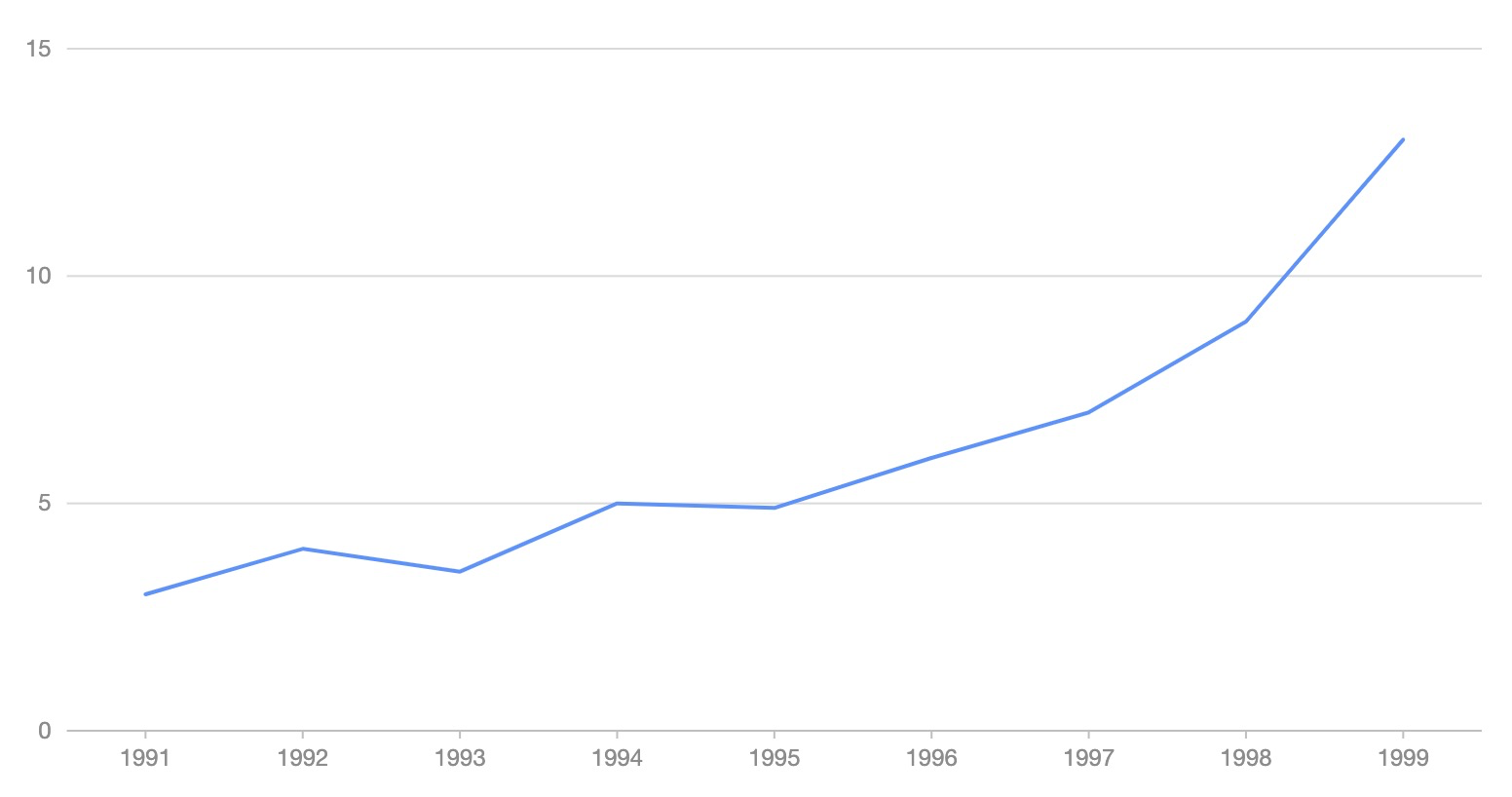
frompyg2plotimportPlotline=Plot("Line") line.set_options({"height": 400, # set a default height in jupyter preview"data": [{"year": "1991", "value": 3 },{"year": "1992", "value": 4 },{"year": "1993", "value": 3.5 },{"year": "1994", "value": 5 },{"year": "1995", "value": 4.9 },{"year": "1996", "value": 6 },{"year": "1997", "value": 7 },{"year": "1998", "value": 9 },{"year": "1999", "value": 13 }, ], "xField": "year", "yField": "value", }) # 1. render in notebookline.render_notebook() # 2. render in jupyter labline.render_jupyter_lab()frompyg2plotimportPlot, JSline=Plot("Line") line.set_options({"height": 400, # set a default height in jupyter preview"data": [{"year": "1991", "value": 3 },{"year": "1992", "value": 4 },{"year": "1993", "value": 3.5 },{"year": "1994", "value": 5 },{"year": "1995", "value": 4.9 },{"year": "1996", "value": 6 },{"year": "1997", "value": 7 },{"year": "1998", "value": 9 },{"year": "1999", "value": 13 }, ], "xField": "year", "yField": "value", "lineStye": JS('''function(){ return{stroke: 'red' }; }''') })Use JS API, you can use JavaScript syntax for callback.
Now, only has one API of pyg2plot.
- Plot
Plot(plot_type: str): get an instance of
Plotclass.plot.set_options(options: object): set the options of G2Plot into instance.
plot.render(path, env, **kwargs): render out html file by setting the path, jinja2 env and kwargs.
plot.render_notebook(env, **kwargs): render plot on jupyter preview.
plot.render_jupyter_lab(env, **kwargs): render plot on jupyter lab preview.
plot.render_html(env, **kwargs): render out html string by setting jinja2 env and kwargs.
plot.dump_js_options(env, **kwargs): dump js options by setting jinja2 env and kwargs, use it for HTTP request.
More apis is on the way.
MIT@hustcc.